


Treatment plan

Developing a breast cancer treatment plan
A treatment plan can be developed once the breast cancer diagnosis, stage and grade have been determined. There are a range of different therapies. In many cases, a combination is used.
Every breast cancer treatment has its pros, but also its cons, such as unpleasant or debilitating side effects, which differ from one patient to another. The healthcare team discusses the available treatments in detail with their patients, who are often given the choice of several treatment options, including surgery.
Each patient’s health, the progression of the cancer, as well as their preferences, fears and objectives are key in establishing the treatment plan, which is based on the following:
- Stage of the breast cancer;
- Whether or not the breast cancer patient is menopausal;
- The hormone receptor status of the cancer;
- The HER2 status of the cancer;
- The risk of recurrence;
- The person’s overall health;
- Other characteristics of the cancer and the person;
- What the person with breast cancer wants.
If you want to start or grow your family, tell your healthcare team about your family plans before treatments begin so fertility preservation strategies can be considered. Learn more about fertility preservation in our informational video Préservation de la fertilité (in French only).
Your healthcare team
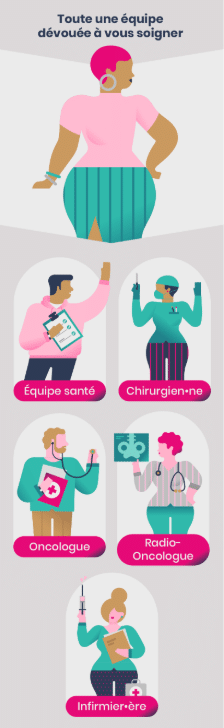
A person with breast cancer is surrounded by a healthcare team formed of one or more of these specialized doctors:
- Medical oncologists, who are experts in cancer and chemotherapy;
- Surgical oncologists, who operate to remove cancerous tumours and can also prescribe chemotherapy in Quebec;
- Radiation oncologists, who specialize in treating cancer by radiation (radiotherapy).
The healthcare team may also include an oncology pivot nurse and other experts such as dieticians, social workers, psychologists, pharmacists and radiation oncology technicians, who are all trained to help people with cancer.
Your pivot nurse: an invaluable resource
An oncology pivot nurse can be more than an intermediary between the patient and the other members of the healthcare team. For some patients, they can be a confidant or a guide who can help them face the new, worrisome and complex reality of fighting cancer.
If you or a loved one is going to be treated for breast cancer, don’t hesitate to confide in your oncology pivot nurse. Tell them what you’re thinking and ask them questions. Along with your doctors, they will inform you about and prepare you for what lies ahead of you, in addition to directing you to other members of the healthcare team as needed. Don’t forget that you can contact our support line at any time.
You can prepare for your doctor’s appointment by compiling a list of questions to bring with you. The doctor will probably anticipate most of your questions, but this list will ensure that you don’t forget anything. You can also bring a loved one for support during these appointments. The more you feel informed about your condition and the treatment options, the more confident you’ll feel about making a decision.
Integrative medicine
Breast cancer treatments can be combined with complementary holistic approaches like yoga, meditation, massage therapy, physical activity and nutrition.
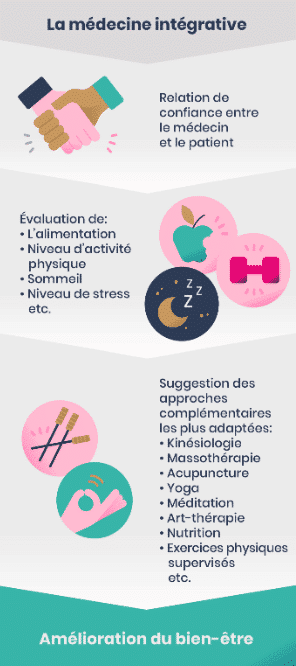
Integrative medicine:
- A new way to understand healthcare that emerged in the United States in the 1990s.
- In this approach, centred on a relationship of trust between doctor and patient, conventional treatments are combined with complementary holistic approaches.
- Goal: to help patients heal faster and experience better care, health, well-being and quality of life.
- A relationship of trust between doctor and patient
- The patient and doctor discuss aspects of the patient’s life such as:
- Nutrition
- Level of physical activity
- Stress level
- Sleep
- Etc.
- The doctor suggests the complementary approaches best suited to improve the patient’s well-being.
- Introduction to the appropriate professionals
- Monitor the complementary approaches selected
- Desired improvement in patient well-being
Proposed integrative medicine approaches:
- Kinesiology
- Massage therapy
- Acupuncture
- Yoga
- Meditation
- Art therapy
- Nutrition
- Supervised physical exercises
- Self-hypnosis
Benefits
These complementary approaches are intended to lessen the pain associated with cancer and side effects from the treatments, such as nausea and fatigue. Some approaches can lower anxiety and stress. Furthermore, they help to integrate better habits, which have a positive effect on overall health. Here are some benefits provided by complementary approaches:
| Complementary approach | Benefits |
|---|---|
| Acupuncture | Controls nausea and vomiting caused by chemotherapy. Lessens pain associated with cancer. |
| Hypnosis | Lessens pain, nausea and fatigue after surgery. |
| Massage therapy | Lessens pain, fatigue, anxiety and nausea. |
| Meditation | Helps with relaxation. Helps improve pain, depression and insomnia management. |
| Physical activity | Increases strength and endurance. Helps improve relaxation and stress management. Lessens pain, fatigue, anxiety and depression. Increases longevity. |
| Nutritional advice | Helps manage weight changes. Helps control nausea. Provides information about which nutritional supplements can interfere with treatment. Provides advice for better health. |
| Yoga | Lessens stress. Helps better control anxiety, depression and insomnia. |
Approaches for feeling better during treatment
It is important to note that complementary approaches are not intended to cure, but rather to contribute to patients’ well-being and quality of life. Their goal is to reduce the unpleasant side effects of chemotherapy, support the patient during their ordeal and improve their quality of life.
Complementary approaches are not a replacement for conventional treatments, but rather a complement to them.
Stopping or interrupting treatments without medical advice entails health risks.
About integrative medicine research
Integrative medicine is a growing field. Several U.S. and Canadian universities have formed groups such as the National Center for Complementary and Integrative Health (NCCIH), which study the advantages and benefits of integrative medicine.
It should be noted that to be considered integrative medicine, the benefits provided by the complementary approaches must have been scientifically proven to be safe and effective.
In Quebec, the CHUM and Maisonneuve-Rosemont hospitals suggest this integrative medicine to their patients. The doctors who practise integrative medicine must be certified. Courses on this topic are provided to oncology residents at Université de Montréal.
Talk to your doctor
Talk to your doctor if you are interested in complementary approaches. They will be able to guide you to the right resources. Although they can be beneficial, some approaches can also be contraindicated. It is therefore essential to discuss them with your medical team and to ensure providers are qualified experts.
References
https://nccih.nih.gov/
https://www.webmd.com/cancer/holistic-treatment-17/integrative-medicine?page=3